The Guillotine Choke: Grappling's Most-Attempted Submission, Explained
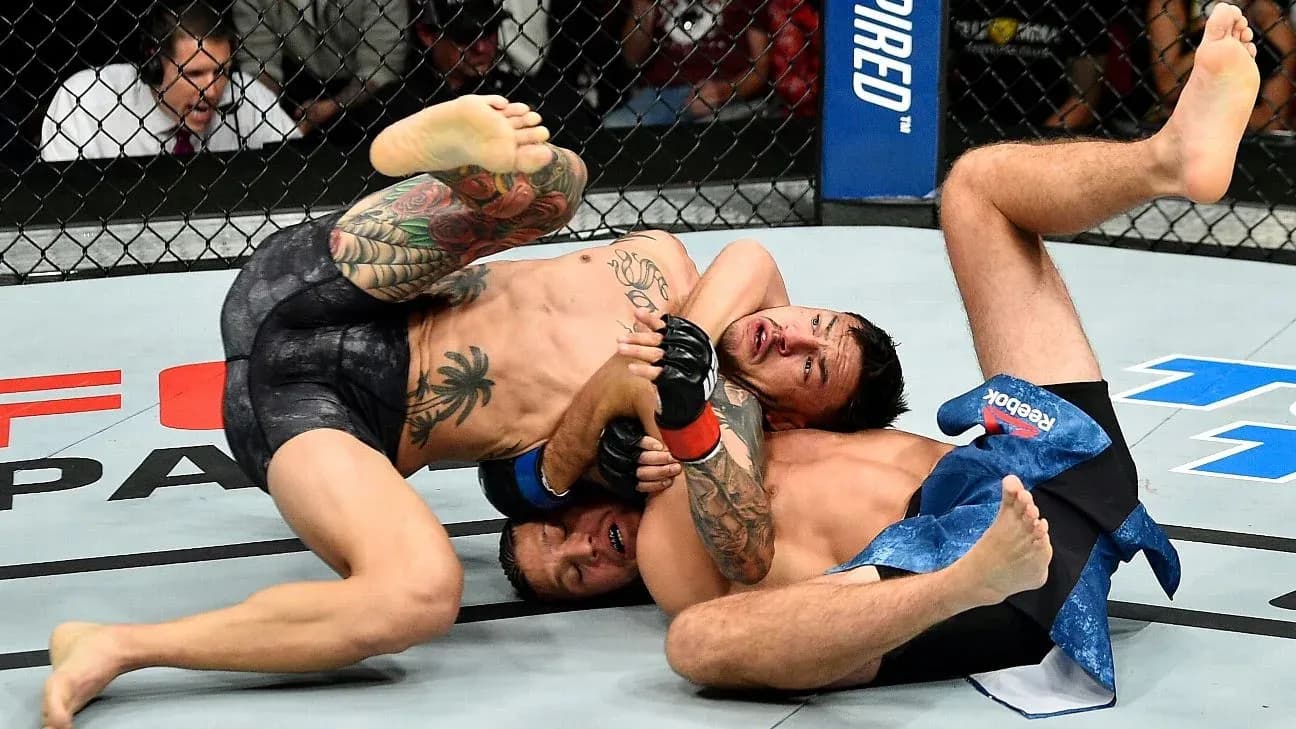
The guillotine choke is the most-attempted submission in grappling - and one of the hardest to actually finish against a trained opponent. That paradox is why you'll see one in nearly every UFC main card and on almost every BJJ open mat.
If you've watched ten MMA fights, then you've seen somebody going for a guillotine choke at least once. And if you have been training in Brazilian jiu-jitsu for a month, you will certainly have felt the pain of the guillotine choke at least once during that time. It is the most natural choke in grappling and, even though it can be easily set up, it is very difficult to land when used against a trained opponent.
In this guide, you will learn what the guillotine choke actually is, where it came from, the five core variations every grappler should recognize, how to set it up and finish it, the mistakes that get you swept instead of a tap, and the most iconic guillotine finishes in UFC history.
What Is the Guillotine Choke?
In simple terms, a guillotine choke involves a choke from the front using the arms to grip around the opponent’s neck. The lead arm goes around the neck of the opponent, while at times taking hold of his/her arm too. The attacker’s hands then lock and apply force.
The choke can work in two completely different techniques based on whether or not the squeezing happens here:
-
As a blood choke, the bone in the forearm applies pressure to the carotid arteries located on the side of the neck, stopping circulation to the brain and resulting in almost immediate unconsciousness.
-
As an air choke, applying pressure on the trachea affects air flow. It’s a much slower process and less efficient; most BJJ schools even discourage it.
Where the guillotine is applied may also create a neck crank, applying stress to the cervical spine. This makes it impossible for the opponent not to tap, yet it is the kind of submission that ends careers and not just rounds, which is why the carotid choke is taught instead.
It can be performed in both standing position and on the ground with one hand or both hands, whether the opponent’s hand is trapped down or free. This ability to apply the technique in various positions accounts for the inclusion of some form of it in all forms of grappling disciplines such as judo, sambo, catch wrestling, BJJ, and MMA. It is also the reason for which combat sports historians regularly describe it as one of the most universal submissions in the sport.
A Brief History: Judo, the Gracies, and Marcelo Garcia
The guillotine choke didn't have one inventor, but it evolved.
The other name used for the guillotine choke is its Japanese mae hadaka jime (前裸絞) or the front naked choke, because this technique can be considered the front version of the rear naked choke. This choke was common in ground fighting (newaza) in judo for about one hundred years before the European and North American catch wrestlers developed a similar technique that is now called ‘front chancery’.
But how this technique came into MMA actually starts in Brazil. It all started with Mitsuyo Maeda, a judoka who arrived in Brazil back in 1914 and started teaching Carlos Gracie from 1917. His techniques were particularly focused on the ground-based approach, unlike most early 20th century judo. The choke holds, such as the mae hadaka jime, were incorporated into the Gracies’ approach to Brazilian Jiu-Jitsu. The Gracies used this guillotine hold in vale tudo matches in Brazil during the next few decades, especially during the 1950s-1970s. By the time UFC 1 rolled around in 1993 the choke was already an important component in the kit of every serious grappler.
The biggest modern innovation came from Marcelo Garcia, a four-time ADCC submission grappling champion and the all-time leader in ADCC submissions. Garcia is often credited with popularizing the high-elbow guillotine, often called the ‘Marcelotine’. He didn’t invent the variation; stories of high-elbow finishes were present even before he got so successful, but the fact that he was dominant in the 2000s, made a large percentage of professional grapplers utilize the move, which also happens nowadays.
How the Guillotine Choke Actually Works
To state the facts, you should know that when applied in the right way, the guillotine doesn’t take long to execute. A 2021 study cited by multiple BJJ sites claims the standard (arm out) guillotine takes 8.9 seconds on average before an opponent is unconscious, whereas an arm-in guillotine takes 10.2 seconds. So, compared to the relatively comparable timing for a rear-naked choke, the guillotine's much more efficient.
How fast does the guillotine choke really work?
|
Type |
Average time for the opponent to be unconscious |
Why |
|
Standard (arm-out) guillotine |
8.9 seconds |
Direct contact by the unprotected forearm across the carotids |
|
Arm-in guillotine |
10.2 seconds |
The opponent's own arm across their body blocks the artery a bit; blood flow is lessened, just not quite as much as in the first. |
|
Rear-naked choke (for reference) |
~9-10 seconds |
Roughly equivalent efficacy despite a superior position |
Source: A peer-cited study of grappling performed in 2021 and summarized by JitsMagazine in March of 2021.
The choke itself functions on three key principles:
-
Bone in the neck: It is actually the radial bone of the attacker's arm, or the bone on the side of the thumb, that directly applies pressure on the carotids, rather than the fleshy part of the wrist.
-
Pressure upwards and into the body: This pressure is generated by pulling with the arms and using a push move from the hip (when attacking from the guard).
-
No escape for the posture of the opponent: When the opponent pushes forward into the attacker or stacks them, the position of the choke changes and the blood choke is lost.
What happens when all three conditions are met? Both carotids will have been compressed and flow to the brain will be shut off, rendering the opponent unconscious in ten seconds or less. If one or both of the carotids fail to be effectively choked, it will be uncomfortable, but survivable, leaving the attacker in an undesirable and usually trapped position below them; that's why Israel Adesanya publicly mentioned that he avoids it.
The Five Core Variations
Guillotine choke variations at a glance
|
Variation |
What's different |
Finishing detail |
Best for |
Notable practitioner |
|
Standard (arm-out) |
Only the neck is encircled |
Squeeze + extend hips from guard |
Fastest tap; classic closed-guard finish |
Many UFC veterans |
|
Arm-in |
Opponent's arm trapped inside |
Pull opponent into you, don't extend |
Higher control, fewer escape paths |
Renzo Gracie |
|
High-elbow ("Marcelotine") |
Elbow lifted above opponent's shoulder |
Sharp angle, brutal squeeze |
Eliminates shoulder-pressure defense |
Marcelo Garcia |
|
Ten-finger |
Open-hand interlocked grip, no clasped hands |
Driving wrists down |
Takedown defense; fast standing setup |
- |
|
Standing guillotine |
Finished without going to the ground |
Control opponent's posture downward, wall them up |
Cage-pressure finishes |
Brian Ortega (vs Cub Swanson) |
1. Standard (arm-out) guillotine
Classic variation. It's only the neck that gets encircled; the opponent's arm remains free. The attacking hand could either be gripped by the other hand or put in the position of a 'blade-of-the-axe'. This is the quickest finisher as evident from the above statistics since there is no added tissue between the forearm and the blood vessel.
The drawback here is that both arms remain free for the opponent, who can then defend.
2. Arm-in guillotine
The opponent’s arm is caught in the choke along with his neck. While the application takes longer (10.2s average), this is because the trapped arm cushions the artery. However, this is a better hold on the opponent, as his structure is fixed, and he has very few ways to escape. Renzo Gracie is mentioned most when discussing the technique. The modification for the finish is also different; while you extend your legs to apply hip pressure (like in the normal version), here you draw the opponent towards you.
3. High-elbow guillotine (Marcelotine)
The Marcelotine is Marcelo Garcia's unique addition to the language of the contemporary submission grappling game. Unlike the regular arm-out guillotine where the attacker's elbow falls by the side of the defender's shoulder, Garcia positions his elbow high above the shoulder line, enabling him to put more pressure on the neck in a very acute angle.
4. Ten-finger guillotine
There are no interlaced hands. In this variant, an 'interlocked fingers' technique with open hands is employed by the attacker. This variant is most widely practiced for a takedown defense: when an opponent shoots, the attacker bends down into a low stance with both hands locking the head in place, applying pressure to the neck via the open grip. It is also practiced in a standing position variant.
5. Standing guillotine
More like an end position than anything else. The same can be done without falling to the floor; the attacker stands and drives the victim down against the floor while maintaining control of his posture and squeezing him. Standing version is not as powerful as the hip-extension for such a good hip snap, but this way you can wall the opponent against the cage or walk them into a wall.
How to Set Up the Guillotine Choke
A guillotine that starts from a good tie-up to conclude in the same position is hardly ever seen; it is almost always achieved via transitions.
The most common setups:
-
Off a sprawl: Your opponent shoots in for a takedown, you sprawl with your hips, and you place your hand around their neck as they reach for your chest in the process. You have set up the front headlock, and you apply the choke via any number of the roughly three to four ways it can be done.
-
From closed guard: When your opponent is in your guard position and postures forward either to attack or advance through your guard, he leaves his neck exposed in your lap. You frame, lock on, and sweep his elbow back.
-
From butterfly guard: This is one of the areas of expertise of Marcelo Garcia. Raise them up, make them to break their posture, and go high-elbow.
-
Counter to a takedown: Even without the sprawl, the 10 finger guillotine applied to the head of an opponent who is attempting to shoot can be a way to end it, as they push themselves further into it.
-
From the back of a turtled opponent: Although a rear-facing twin or rear-naked guillotine is more common from this position, a front guillotine can also be applied as they go flat.
What remains constant in all these holds is that the guillotine punishes an incorrect position on behalf of the opponent. This is a position wherein the attacker's body is bent forward, without any posture at all, and his head is under the chest level of the attacker. It is not a hold which you force; it is a hold which you trap into.
How to Finish the Guillotine Choke
As soon as you lock the choke, the way you finish it depends a lot on which variation you're in:
-
Standard / arm-out from closed guard: grip with hands, bring the forearm across their neck area, squeeze with knees against the side of the ribs, and drive hips forward. It is the hips driving through that makes them tap.
-
Arm-in from closed guard: do not put the hips into extension; pull the opponent towards you, drive with your shoulder, and grip.
-
High-elbow (Marcelotine): the elbow needs to be above the level of the opponent’s shoulders. If not, the choke becomes a slower regular arm-in. When above, squeeze hard because the finish takes less than five seconds.
-
Standing: the opponent’s head should always be pulled downwards. Ideally wall the opponent against the cage or try walking him into a sprawl position to create hip pressure.
The single most common finishing technique mentioned by everyone: avoid gripping the opponent’s wrist using the opposite hand. This gives the opponent an opportunity to escape and spin out. Always use palm-to-palm or palm-to-forearm grips; wrists should be avoided.
Common Mistakes & How to Fix
Most failed guillotines die from the same small handful of errors:
|
Mistake |
Why it fails |
How to fix |
|
Dropped elbow |
Pads applied to shoulder muscle, choke depressurizes |
Maintain the elbow above the line of the opponent’s shoulder (particularly in high elbow/Marcelotine) |
|
No hip extension (standard variation) |
Arms alone won’t take down a skilled grappler; hips are the power engine |
Press knees into opponent’s ribs; hips move forward and upward |
|
Letting the opponent stack |
The pressure between forehead and hips breaks down the choke angle |
Do not allow knees to rise over shoulders when maintaining guard pressure |
|
Getting passed mid-attempt |
The lack of tightness in the closed guard while attacking makes for easy side control |
Close your guard or have butterfly hooks set up for escape |
|
Muscling a defended choke |
But if you’re not tight within two seconds, squeezing more won’t help; you’ll only get gassed |
Bail out to a sweep or transition, return to it at another point during the match |
|
Wrist grip instead of clasp |
Your opponent may turn out of it |
Wrap palm-to-palm or palm-to-forearm; never grab the wrist |
Defending the Guillotine
-
Posture up right away: Keep a long spine, head up and eyes forward. Why do most of the guillotines miss? Just because the fighter does not get this posture established.
-
Hand fight the hold: According to Israel Adesanya, you should get under the arm that is choking you with one hand and use the other hand to control the attacker’s wrist because an attacker is committed to the choke, they are also committed to being underneath you, and that means that usually, they lose out in the fight because the defender just does not give up.
-
Pressure into the choke from the shoulder. Then use the shoulder on the same side of the body to push the grip off your neck and turn to face the other side.
-
Drop and stack. If you don’t know what to do, you simply go down to the attacker’s hip and pass to gain control. This is used at a high percentage as an escape in MMA.
And that is the main flaw in the design of the choke, which is why Adesanya's comment was spot on. The attacker remains at all times in an inferior position that he can not use to deliver any strikes. For example, if the defender is twenty seconds away, the position often turns around.
Famous Guillotine Choke Finishes in UFC History
A handful of specific finishes that illustrate the variations in action:
|
Date |
Winner |
Loser |
Event |
Variation |
Round |
Time |
Notes |
|
Dec 12, 2009 |
Frank Mir |
UFC 107 |
Standing → ground |
1 |
1:12 |
Dropped Kongo with a left hook then locked a no-arm-in guillotine; technical submission (Kongo went limp before tapping) |
|
|
May 30, 2015 |
Charles Oliveira |
Nik Lentz |
Guillotine |
3 |
1:10 |
- |
|
|
Dec 19, 2015 |
Myles Jury |
UFC Fight Night 80 |
Guillotine |
1 |
3:05 |
- |
|
|
Dec 9, 2017 |
Brian Ortega |
Cub Swanson |
UFC Fight Night 123 (Fresno) |
Standing |
2 |
3:22 |
Squeezed Swanson out against the cage while both men were still on their feet |
|
Jun 9, 2018 |
Charles Oliveira |
UFC 225 (Chicago) |
Standing |
1 |
2:18 |
- |
|
|
Mar 14, 2020 |
Charles Oliveira |
Kevin Lee |
UFC Fight Night: Lee vs. Oliveira (Brasília) |
Off takedown attempt |
3 |
0:28 |
Anticipated Lee's double-leg; choke was locked before Lee's hips drove through |
Four UFC finishes by Oliveira using the guillotine choke against different opponents and in different setups demonstrate the versatility of the technique. At times he used it to finish opponents coming out of a scramble position, other times a failed takedown attempt.
Why Is This Grappling's Most-Attempted Submission
Were someone to monitor every single submission attempt made in UFC history and sort them based on frequency, the guillotine choke would have to be the leader among them. It is not because this submission is more readily finished, the rear naked choke could probably take that prize, but rather because it is one of the easiest submissions to obtain. Anytime a fighter attempts a poorly executed takedown, anytime a kickboxer hangs his head to come in, anytime a wrestler is trying to stand from the bottom, the front headlock is right there, and the guillotine is the natural next step.
That’s also why the guillotine rarely works. They’, the trained opponents, are ready for it. Postural defense against it is taught from white to black belts. Guillotine finishing technique, elbow up, hip extended, no wrist lock, is difficult enough that most people do not apply it correctly when they are fatigued.
But every now and then someone gets it perfectly right at the exact right moment, and it takes less than ten seconds to win the match. That is the attraction. This is why every grappler keeps practicing it.